
With Iacoletti Software, you can have AI working for you.
Open moviemakerstudio.iacolettisoftware.com
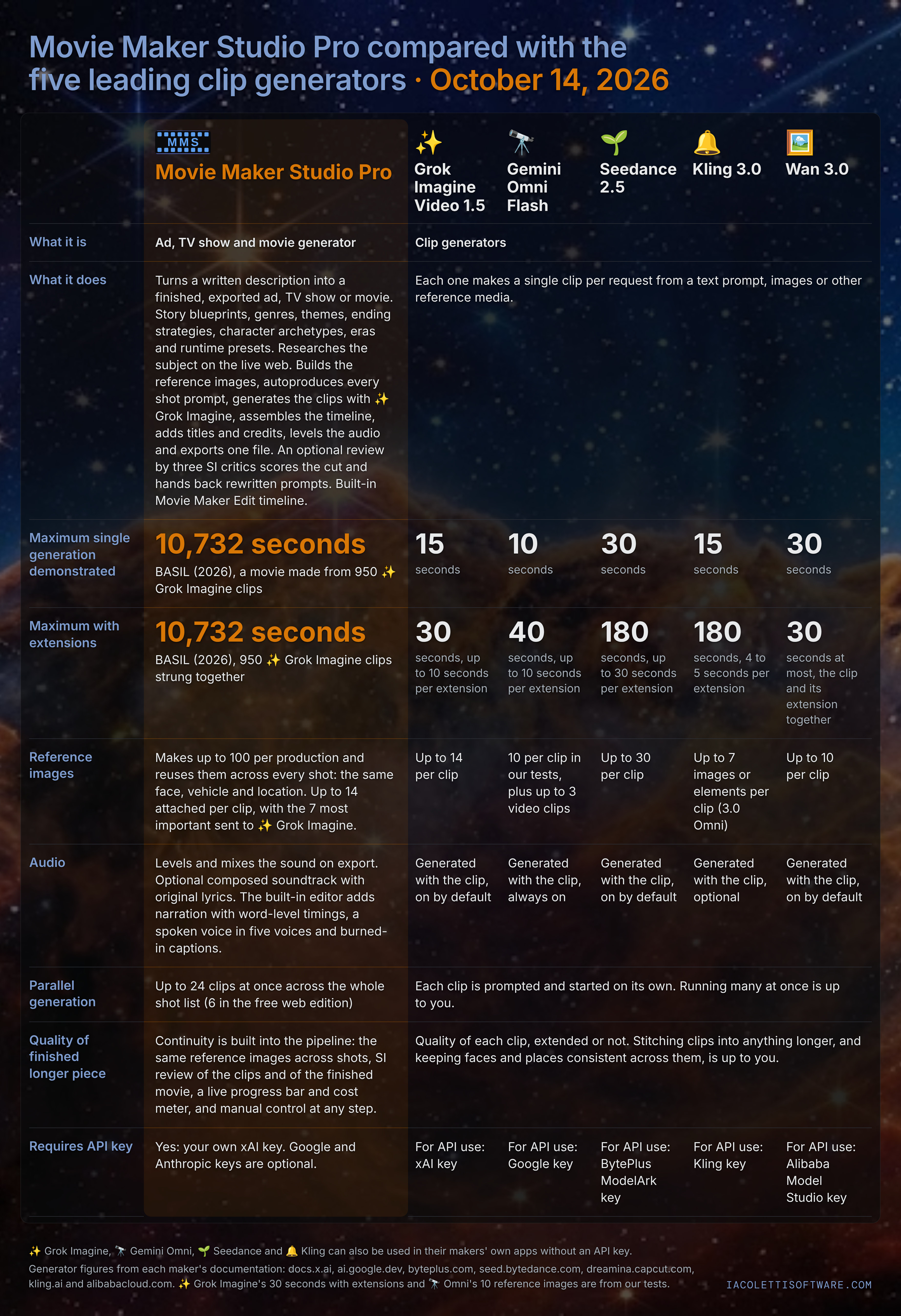
Movie Maker Studio Pro 7.3, Desktop Edition, turns a written description into a finished ad, TV show or movie. No crew. No cast. No camera. No permission, and no skill: describing what you want is the whole job.
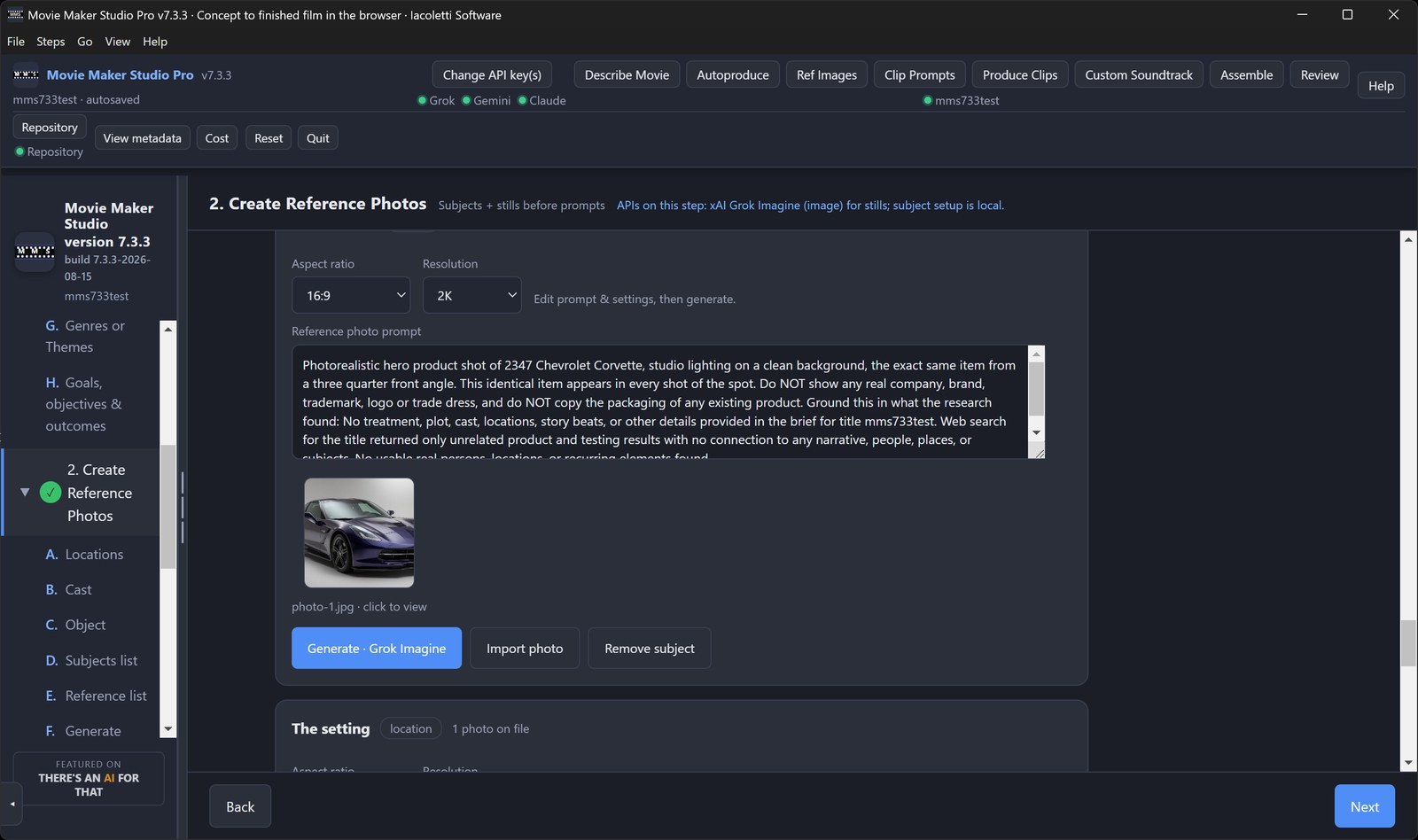
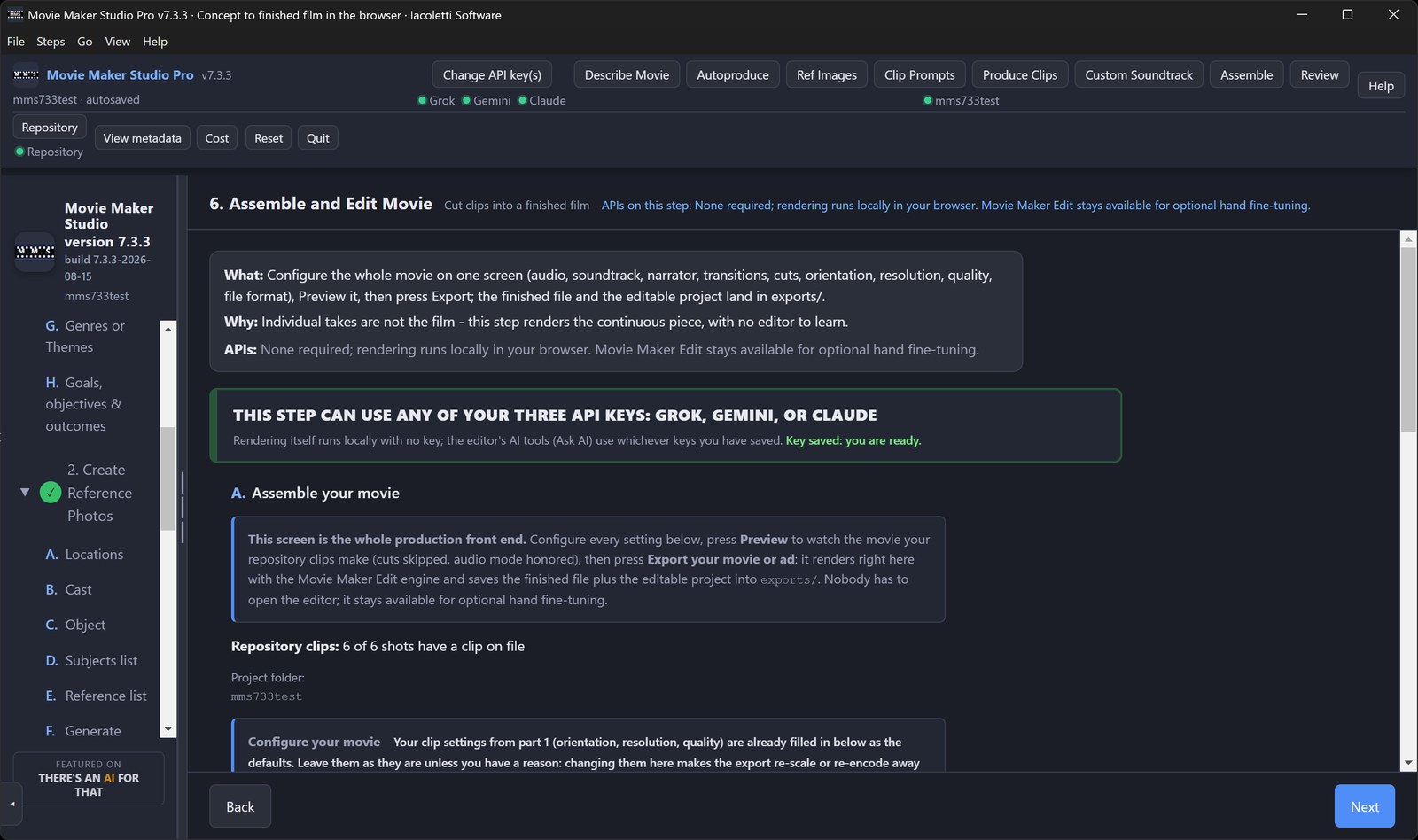
You start with your own xAI API key, which pays for the clip production, 6 to 15 second image to video clips, and a short description of what you want to make. Movie Maker Studio takes it from there. It shoots the reference images, writes every prompt, generates the clips on Grok Imagine, assembles them and exports the finished file as MP4, MOV or WebM, at any length up to 150 minutes.
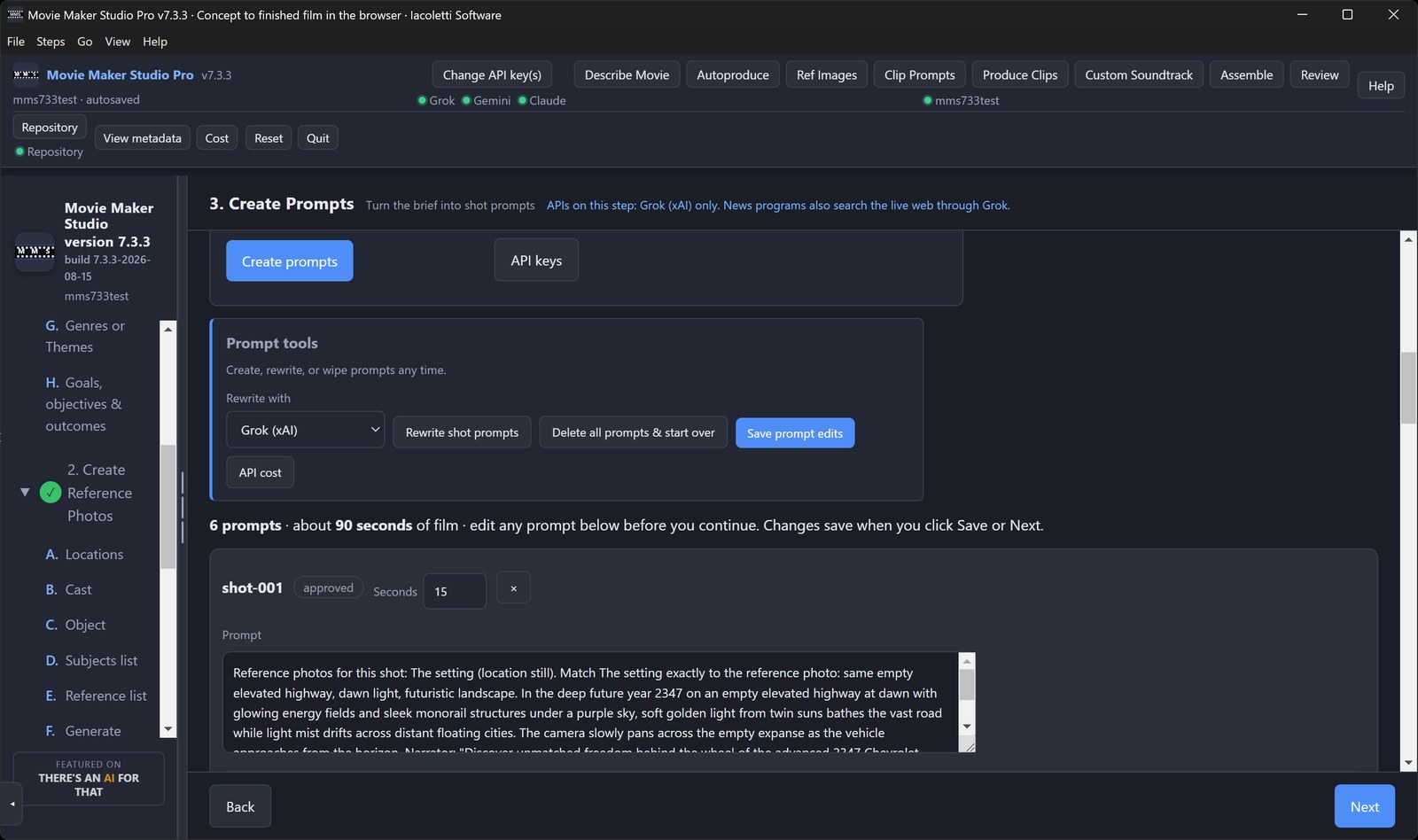
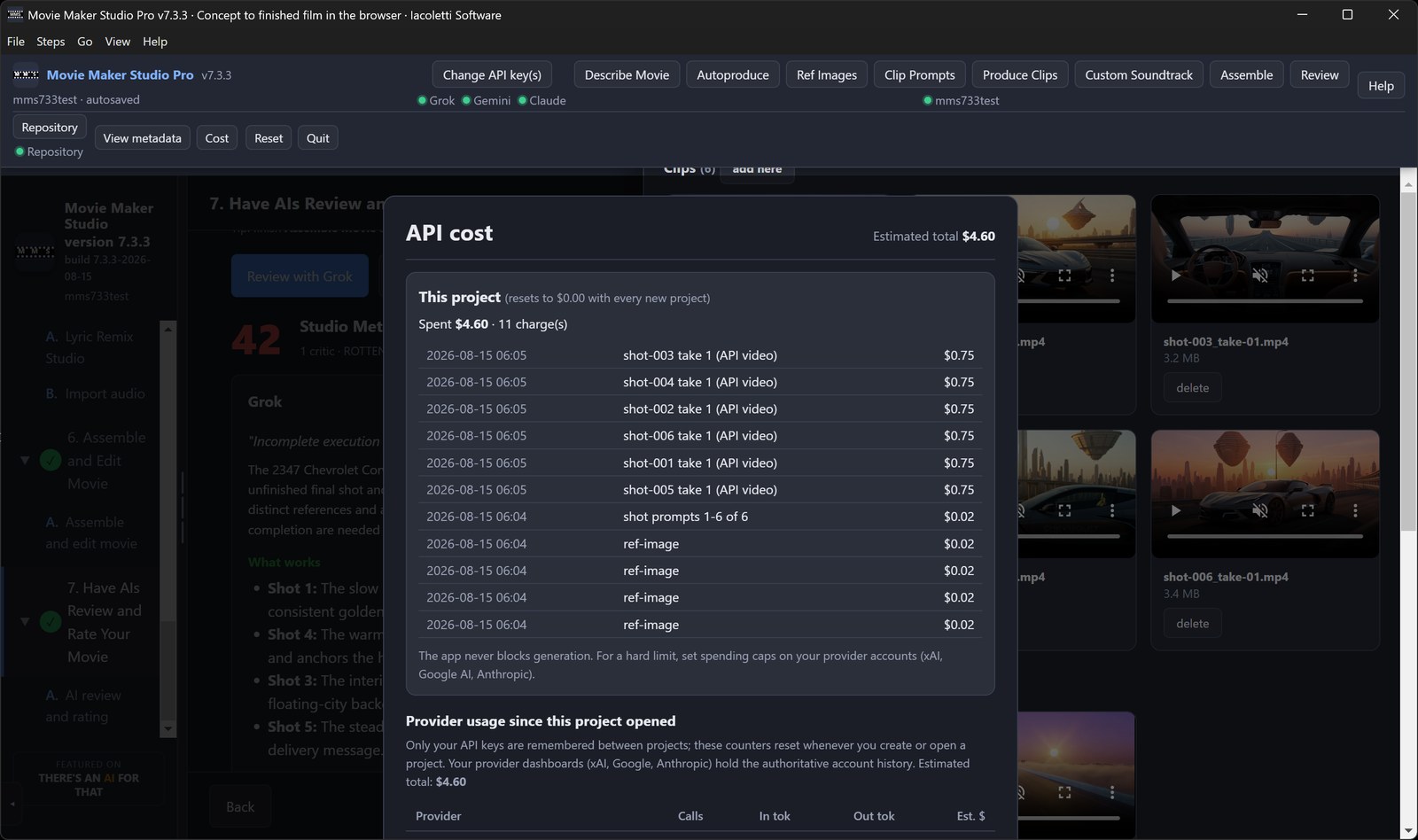
Describe the piece on one screen. Press Auto-produce. Get a finished, exported ad, TV show or movie. It shoots the reference images, writes every shot prompt, generates the clips, approves them, cuts the timeline, normalizes the audio and exports the file. Every stage surfaces a live progress bar and a running cost meter, so you know what has been done and what is still in flight without going looking for it.
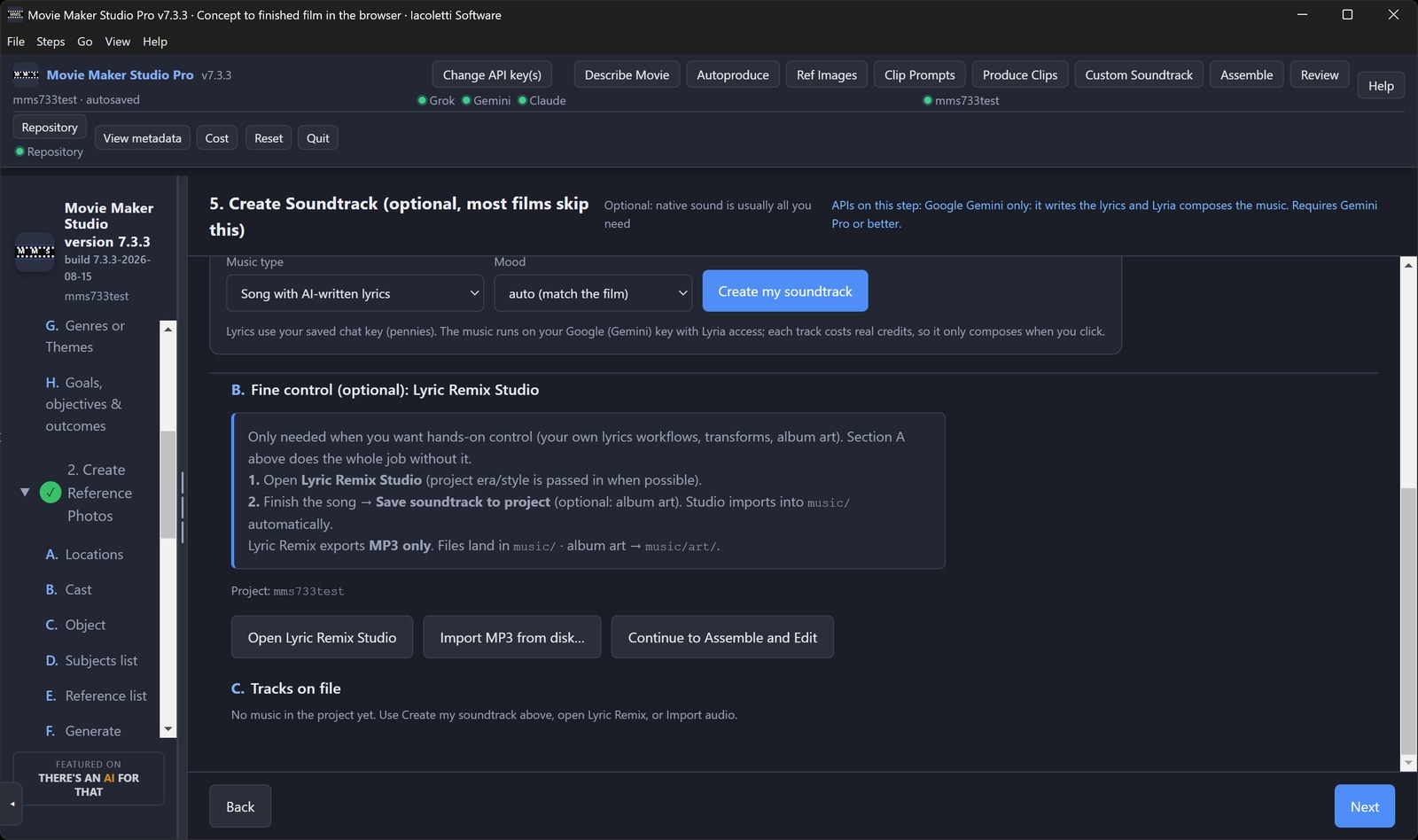
You never face a blank page. You choose instead: story blueprints, each carrying its own story structure, along with genres, themes, ending strategies, character archetypes, historical eras and presets matched to real broadcast and social runtimes. Reference images are what hold the movie together. The same face, the same car and the same room appear in every shot, so continuity becomes a property of the pipeline rather than a lucky accident. Every production goes out on the live web first and researches the subject you entered, so the detail in it is real. An optional stage adds a soundtrack composed for your production, with lyrics written for it.
Prefer to drive it yourself? A seven step manual path stays available at every moment. Edit any prompt, regenerate individual clips, assign specific reference images per shot, and control transitions, audio mix, resolution and quality. Switch between automatic and manual freely, mid-production. Nothing is locked once Auto-produce has run. Finished videos open in the Movie Maker Edit timeline built into the app, so you keep cutting without leaving the product.
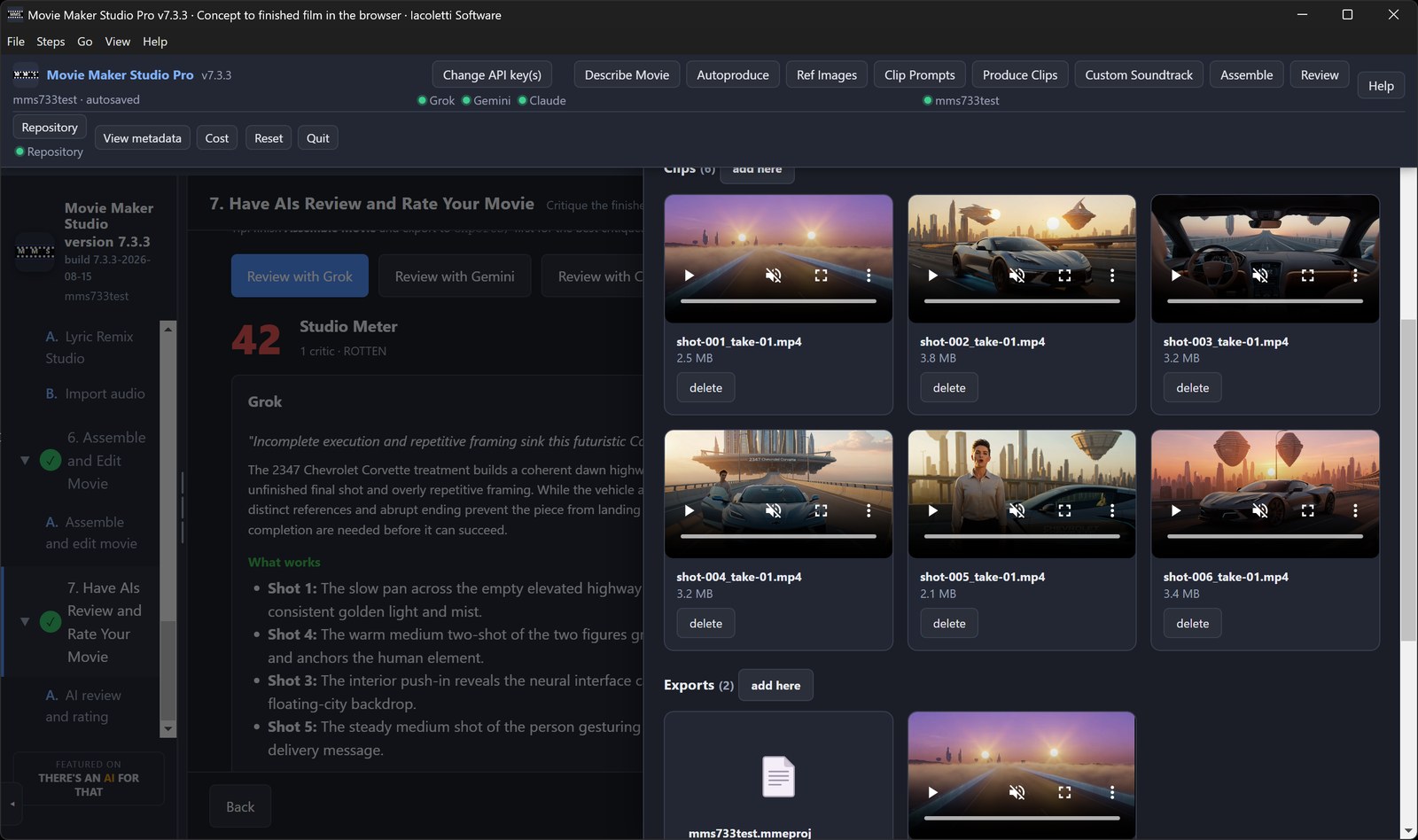
An optional review pass puts three independent AI critics on your finished cut. They score it, flag problems shot by shot and hand you rewritten prompts ready to regenerate.
A free browser based edition is there to try before you buy, for shorter ads, TV shows and movies. The difference is parallelism. A browser tab cannot reach your graphics hardware and cannot hold a long timeline in memory, so it generates 6 clips at once and stops at 46 minutes. This Windows edition puts your machine's cores and GPU behind the work, with hardware acceleration on NVIDIA, AMD and Intel graphics, and generates 24 clips at once, which is 24 simultaneous camera setups. No production crew on earth can do that, and it is what makes it fast: a full episode is shot in a handful of rounds rather than one take after another, so you can make videos faster than you can watch them, all the way to 150 minutes. Movie Maker Studio Pro, Desktop Edition, is $199.99 once, in the Microsoft Store and on Gumroad and Lemon Squeezy.
REQUIRES YOUR OWN API KEY. An xAI key is required; Google and Anthropic keys are optional. Generation is billed by those providers directly to your accounts.
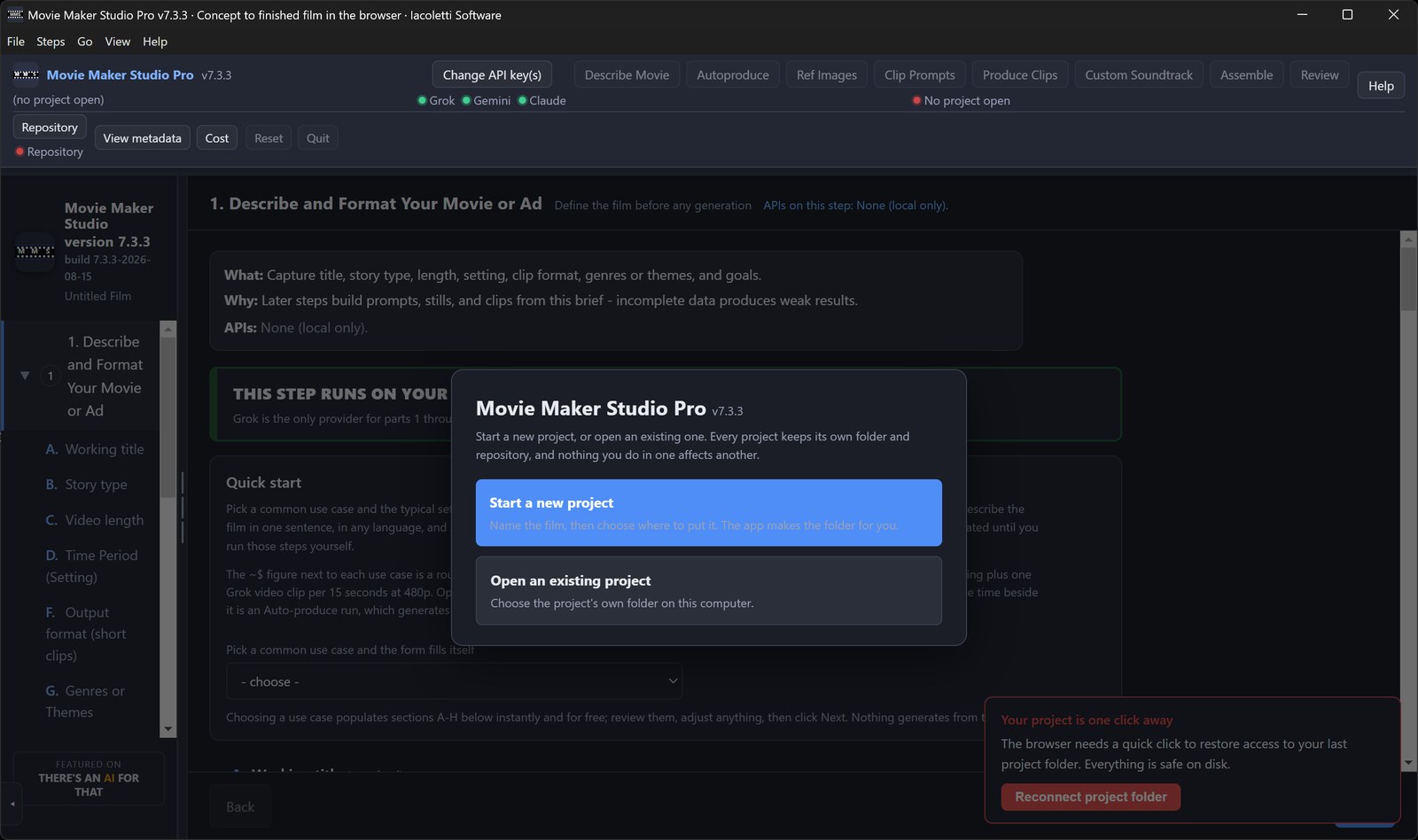
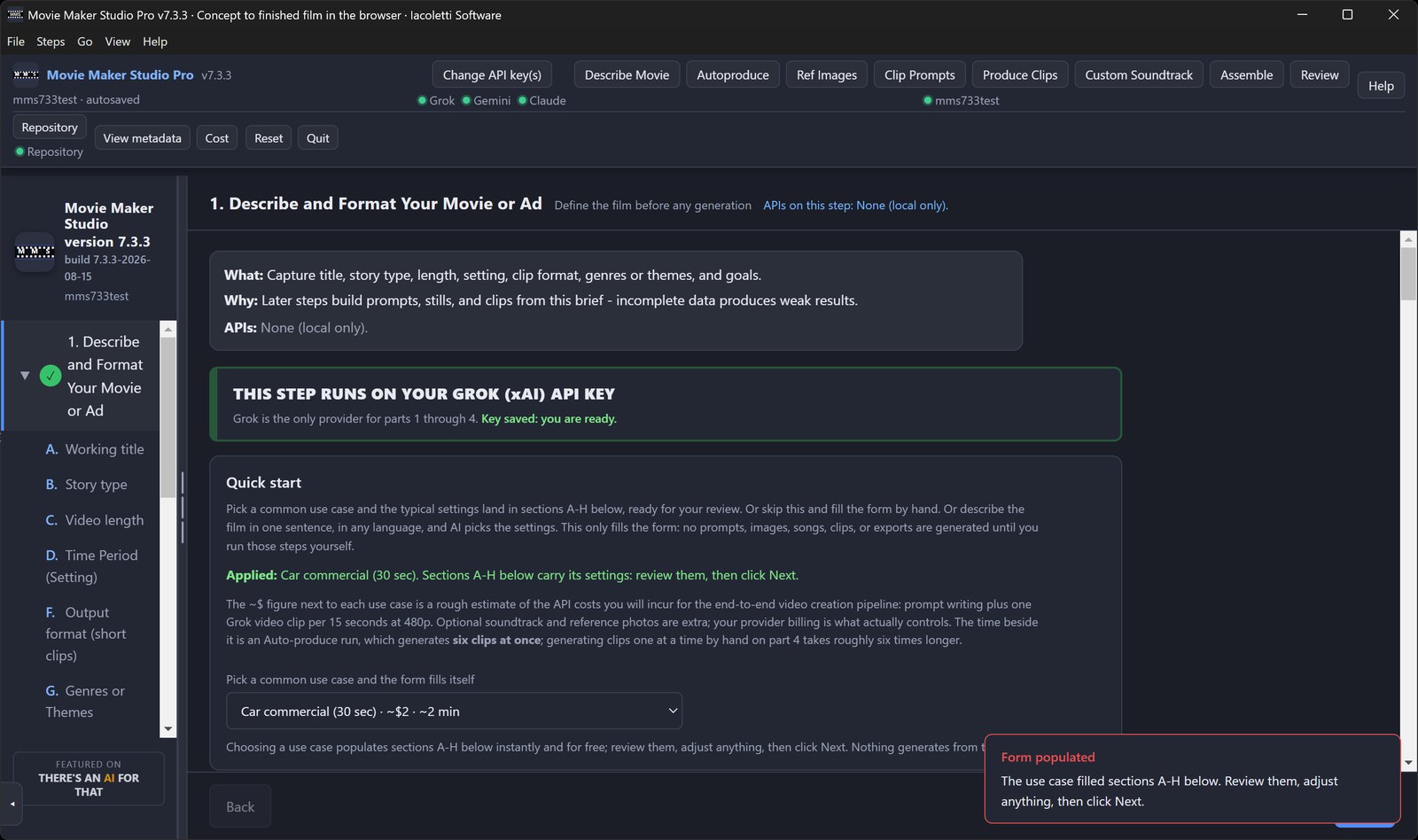
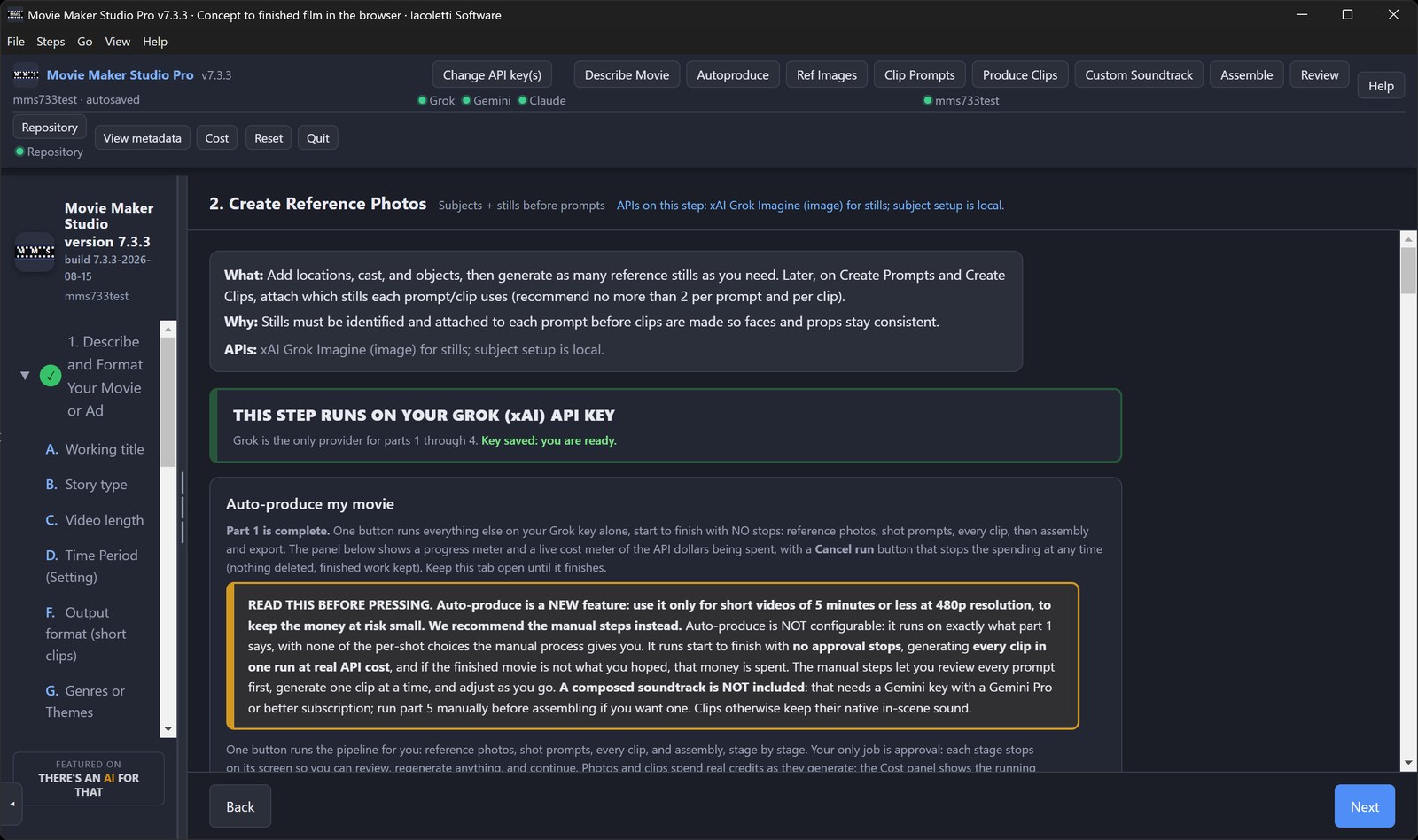
Ten screens, in the order the work happens. Click through them.
1 of 10
$199.99, one-time. No subscription, no account, no watermark. Buy from the Microsoft Store, Gumroad or Lemon Squeezy; the free browser edition needs no install.
Open moviemakeredit.iacolettisoftware.com
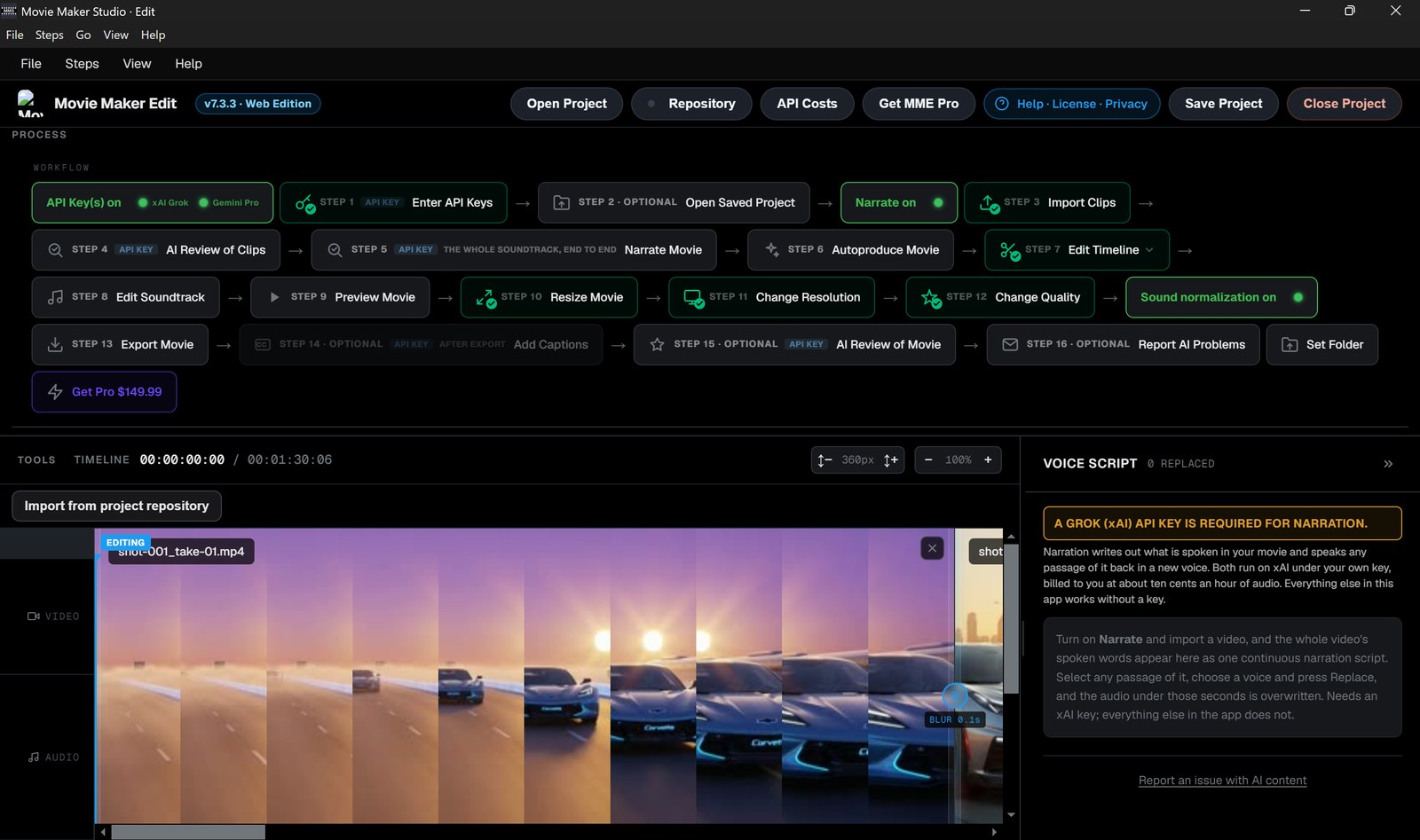
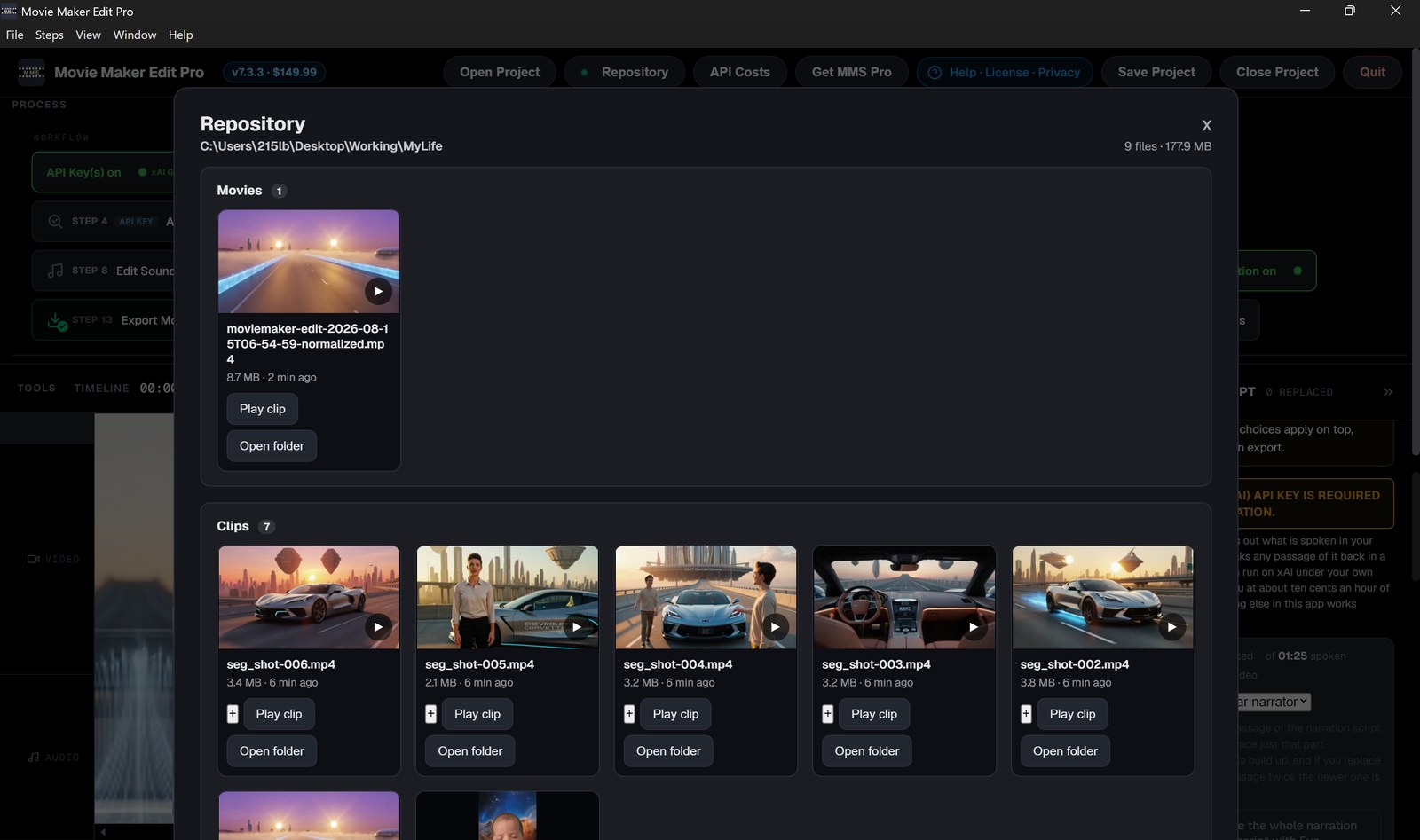
Grok Imagine and Veo produce 6 to 15 second clips. Point Movie Maker Edit at the folder and get a finished, exported movie. It does not care where the clips came from.
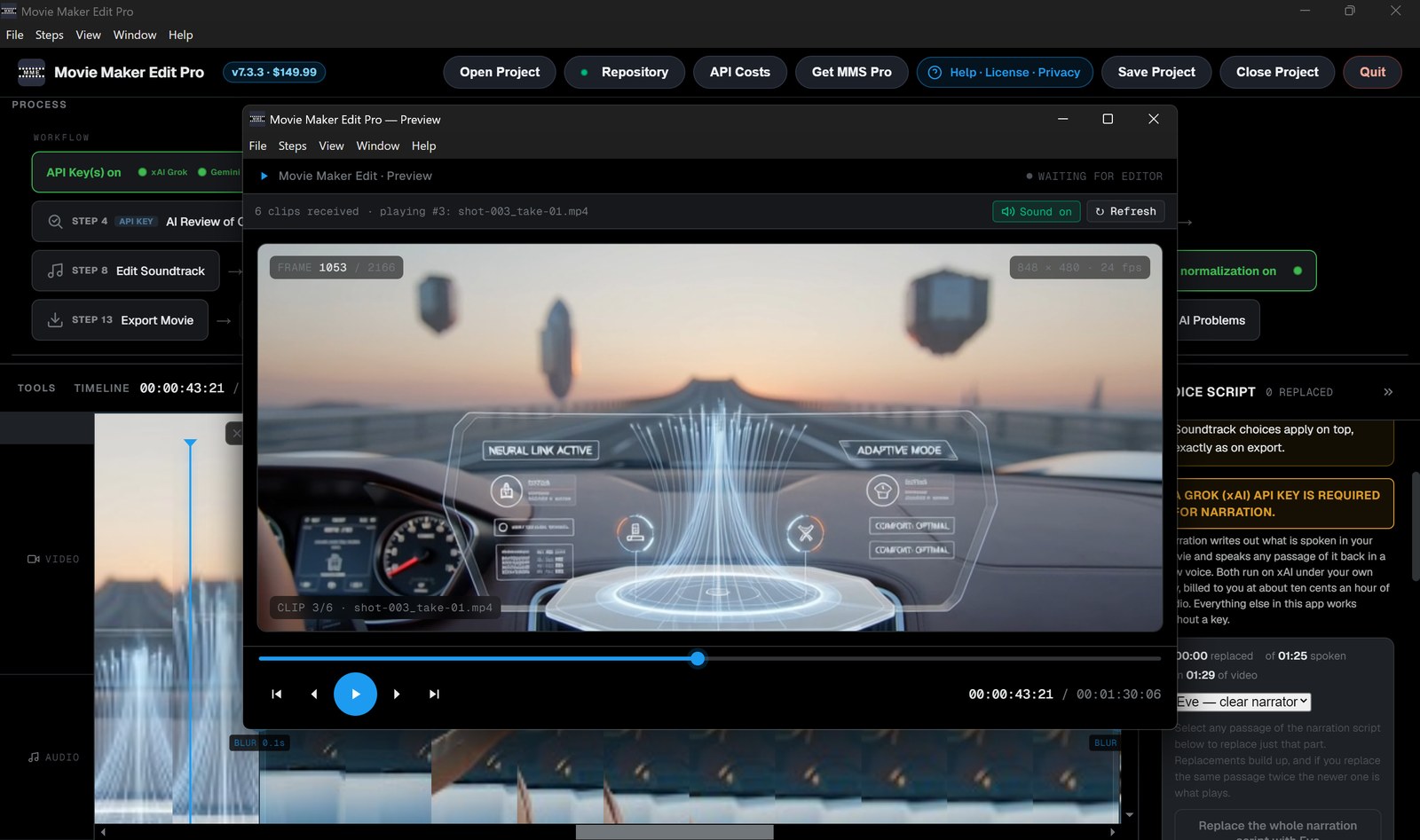
Point it at a folder of clips. Press Autoproduce. It reads every clip, orders them, sets the transitions, renders the movie and levels the sound, reporting what it produced at every stage. State is written before every stage, so a run that halts picks up exactly where it left off rather than starting over, and Cancel takes effect immediately on work already in flight, so stop means stop. Add an API key and it checks every clip with AI on the way through.
Movie Maker Edit, Web Edition is free and runs in any browser, including Windows, Mac, iPad and Android, with no installation, no account and no watermark. Both editions share a project format, so a movie you start in a browser finishes in Pro.
How long it actually takes, end to end rather than the render alone. A 2 minute video of 9 clips runs about 10 minutes in the browser and 5 in Pro. A 10 minute show of 43 clips, about 45 minutes in the browser and 8 in Pro. A 30 minute program of 129 clips, about 2 hours 20 in the browser and 20 minutes in Pro. A 90 minute feature of 386 clips is Pro only, under an hour, and a 150 minute feature of 643 clips about an hour and a half. Most of that clock is at the front, pulling a poster frame out of every clip on import, and Pro caches those to disk so a project you reopen loads instantly. Those are real runs: Alternative Dimensions, an 82 minute feature cut from 347 Grok Imagine clips, imported in 20 minutes and was a finished, leveled movie inside the hour.
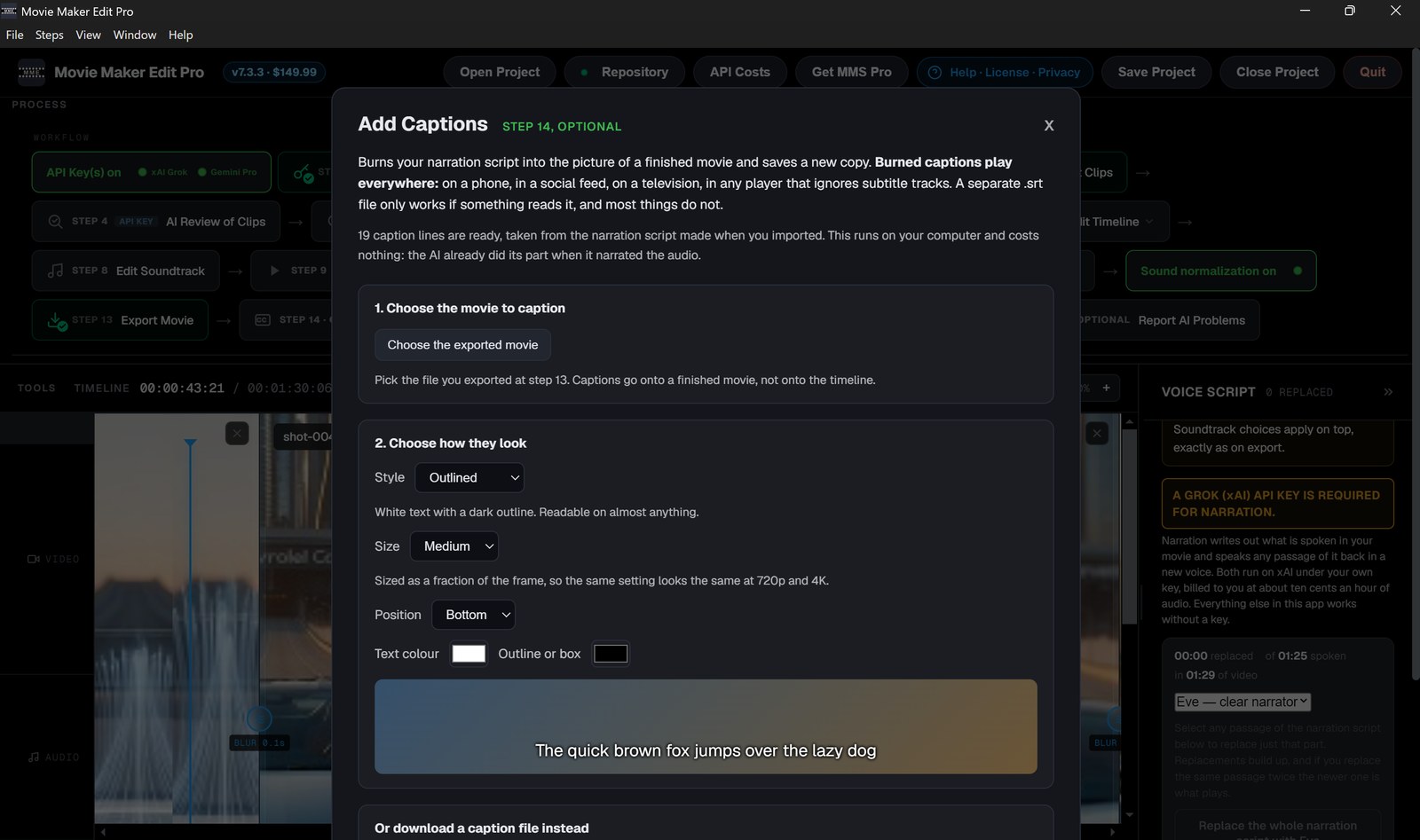
Five AI tools sit on top. All five run on a Grok or Google key you supply and pay for directly. AI Review of Clips catches what a human eye slides past on the twentieth viewing, watching a 15 second clip once: scrambled text on a sign, a car with no far side, a face that morphs, a frozen last second, a jacket that changes color between shots. It looks at frames through every clip, names the broken ones and tells you exactly what is wrong, so you regenerate them before the render instead of finding out on a big screen with the generator session long gone, and it matches your export settings to your actual footage. On a long production it hands you the short list instead of making you watch everything twice. AI Review of Movie puts three critics on your finished cut, scoring it out of 100 and naming what works, what does not, and what you can fix right here. Narration returns word-level timings and speaker labels, editable, out as SRT or WebVTT. Spoken voice reads any line you type in one of five voices. Add Captions burns them into the picture in five styles, four sizes, three positions and your own colors, with a live preview.
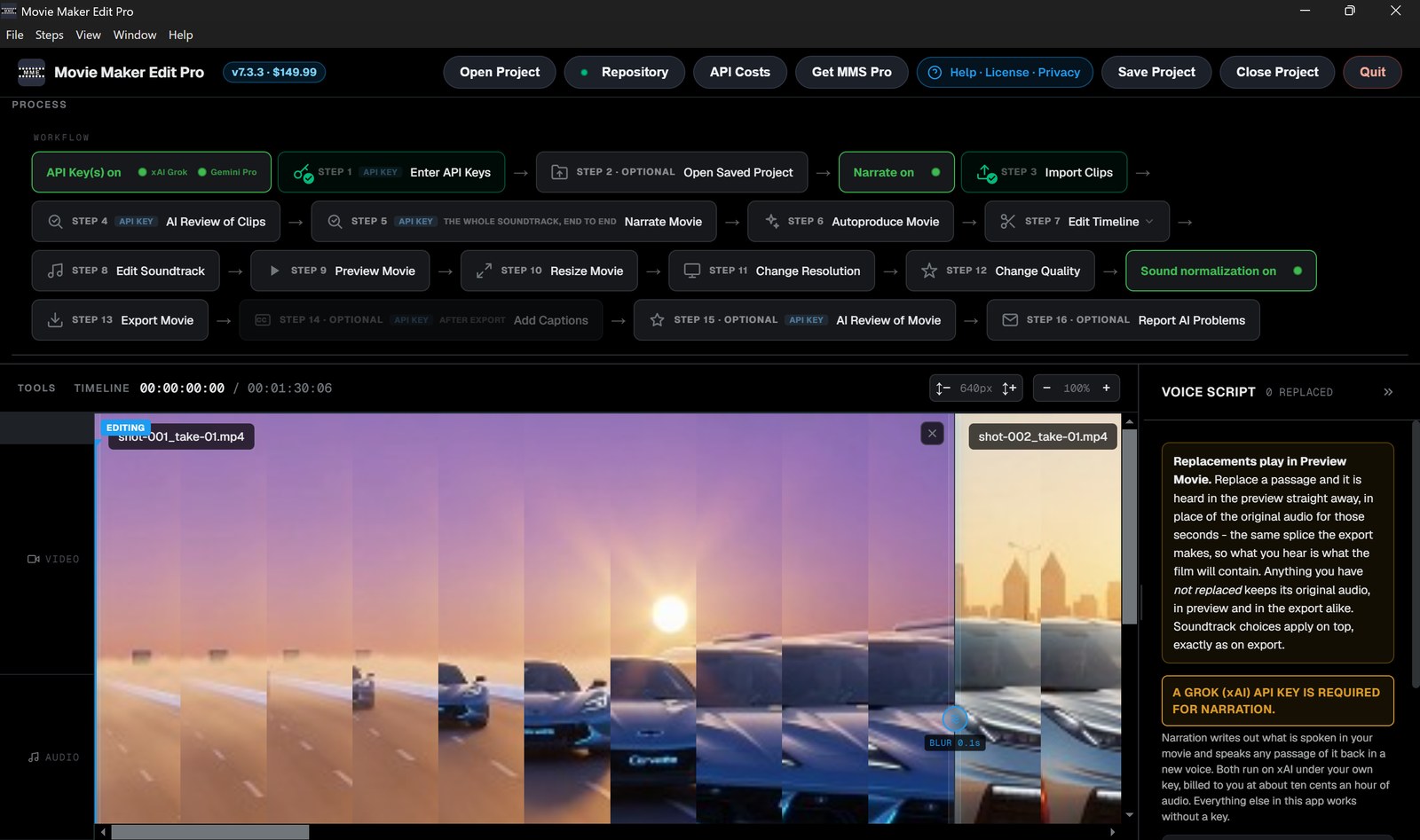
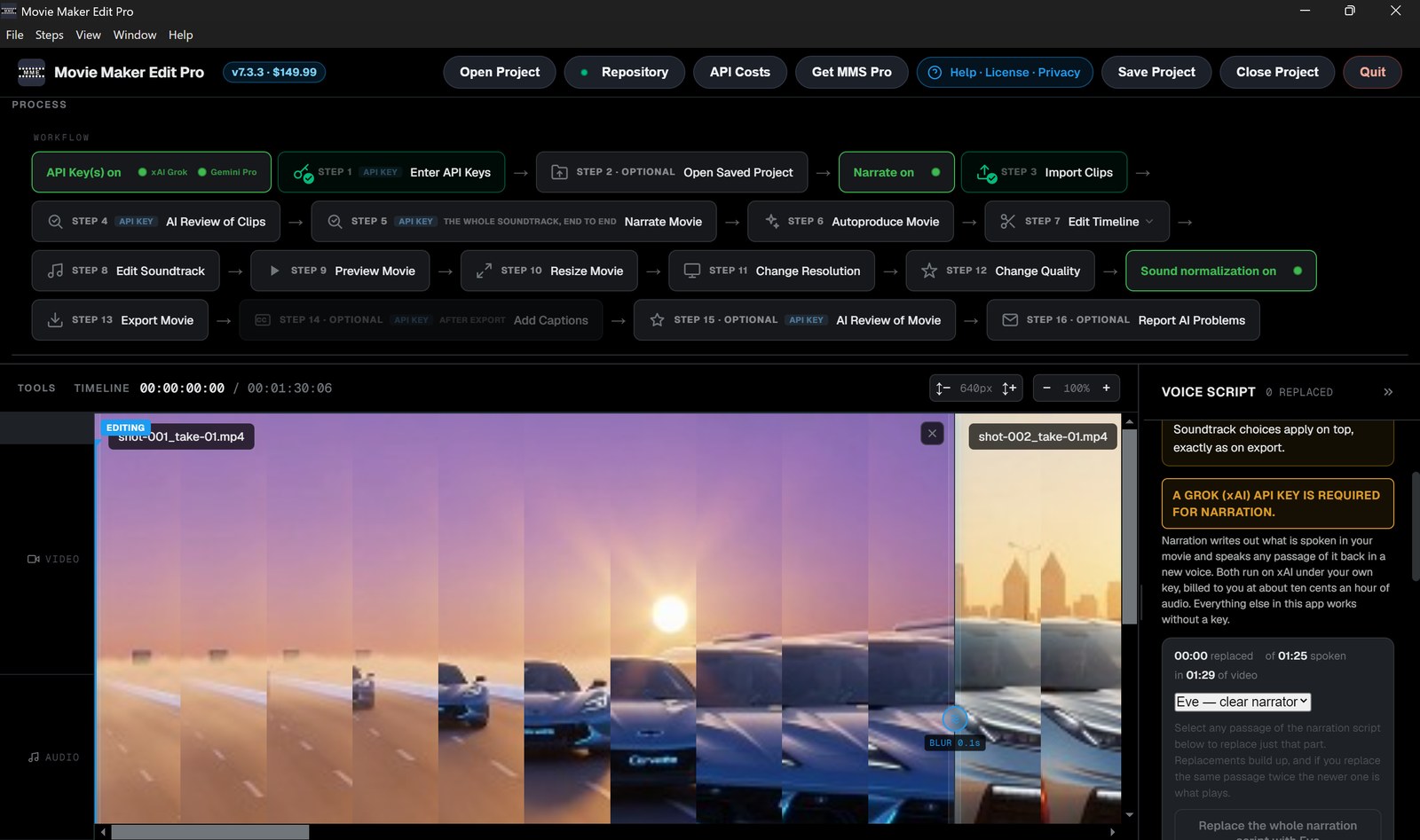
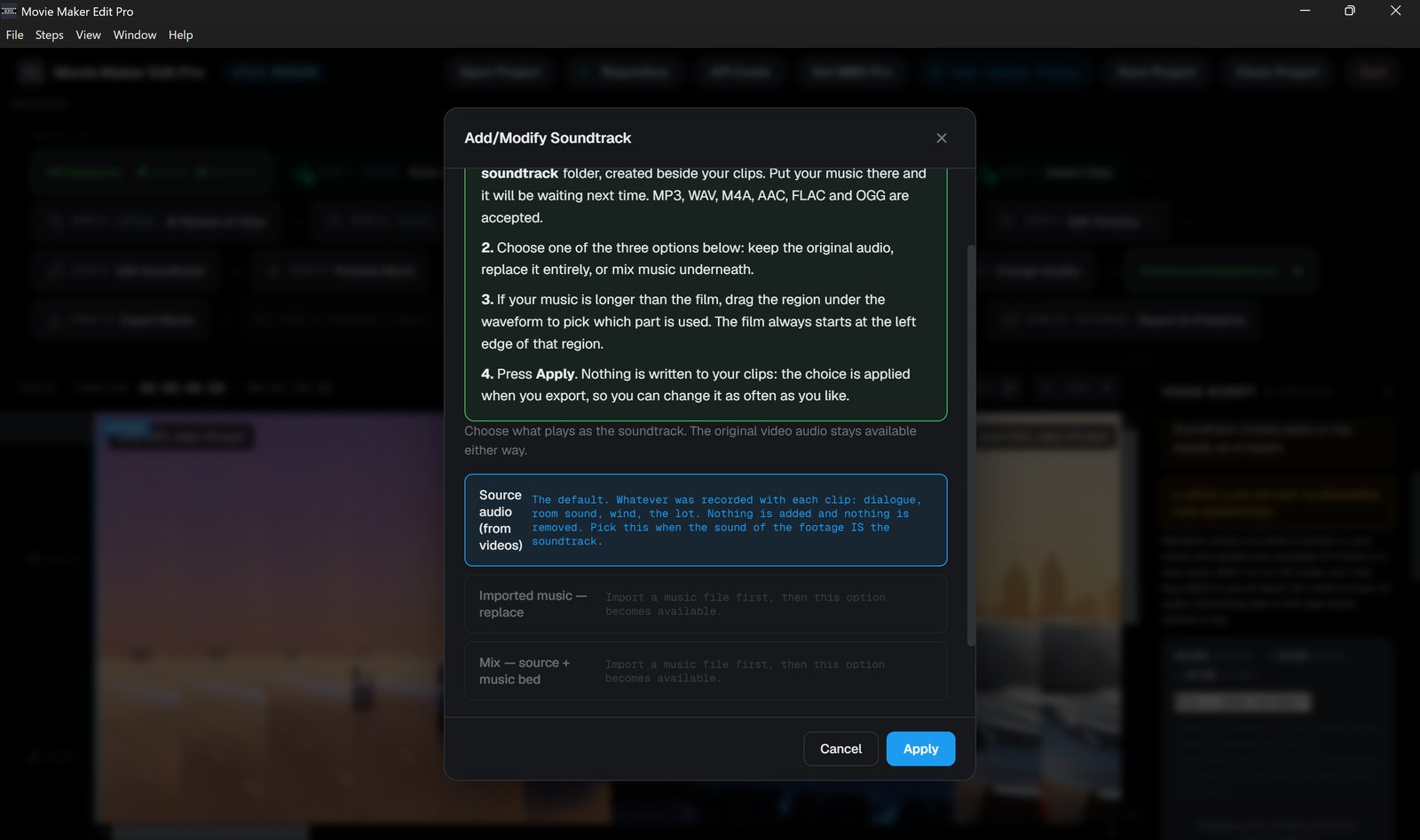
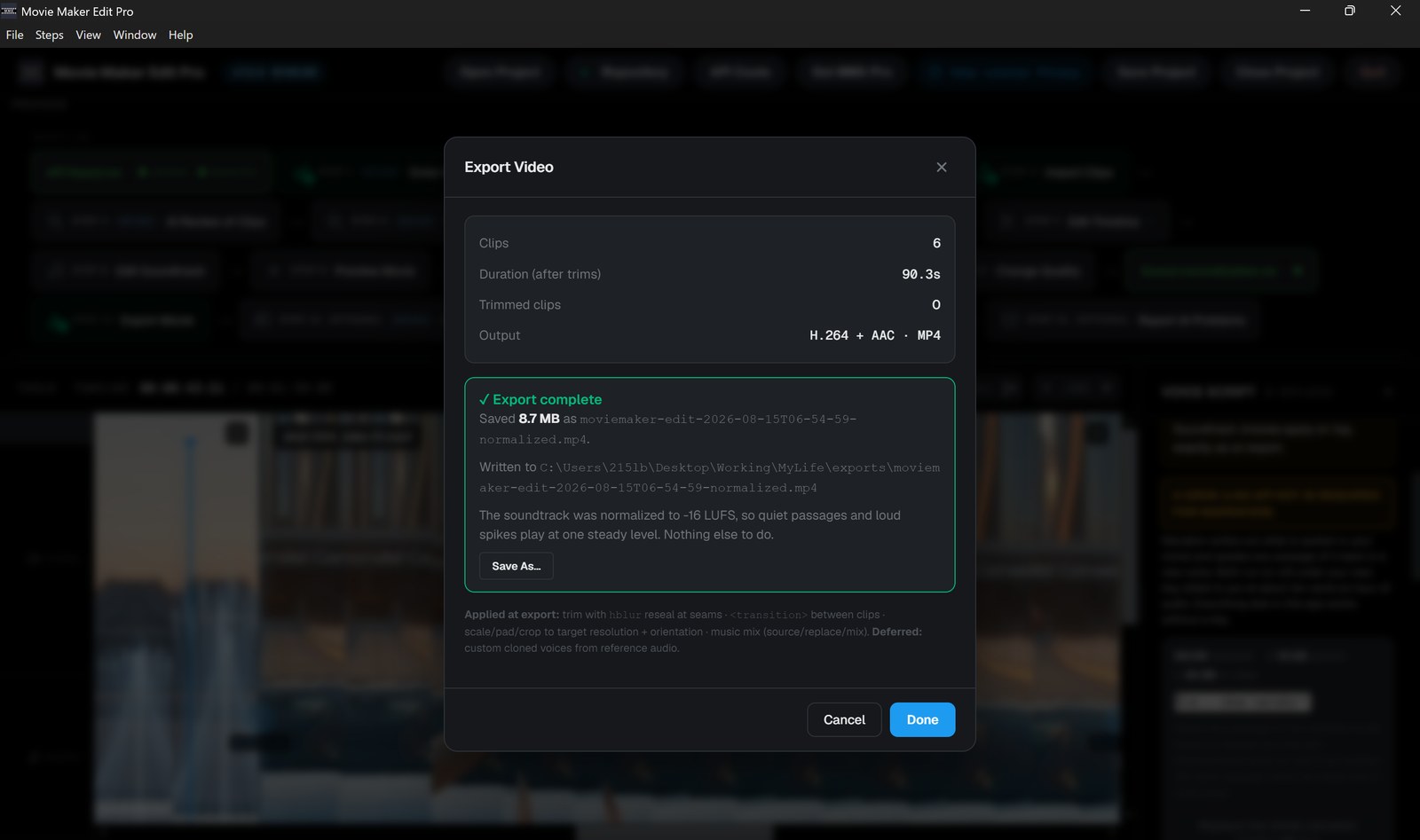
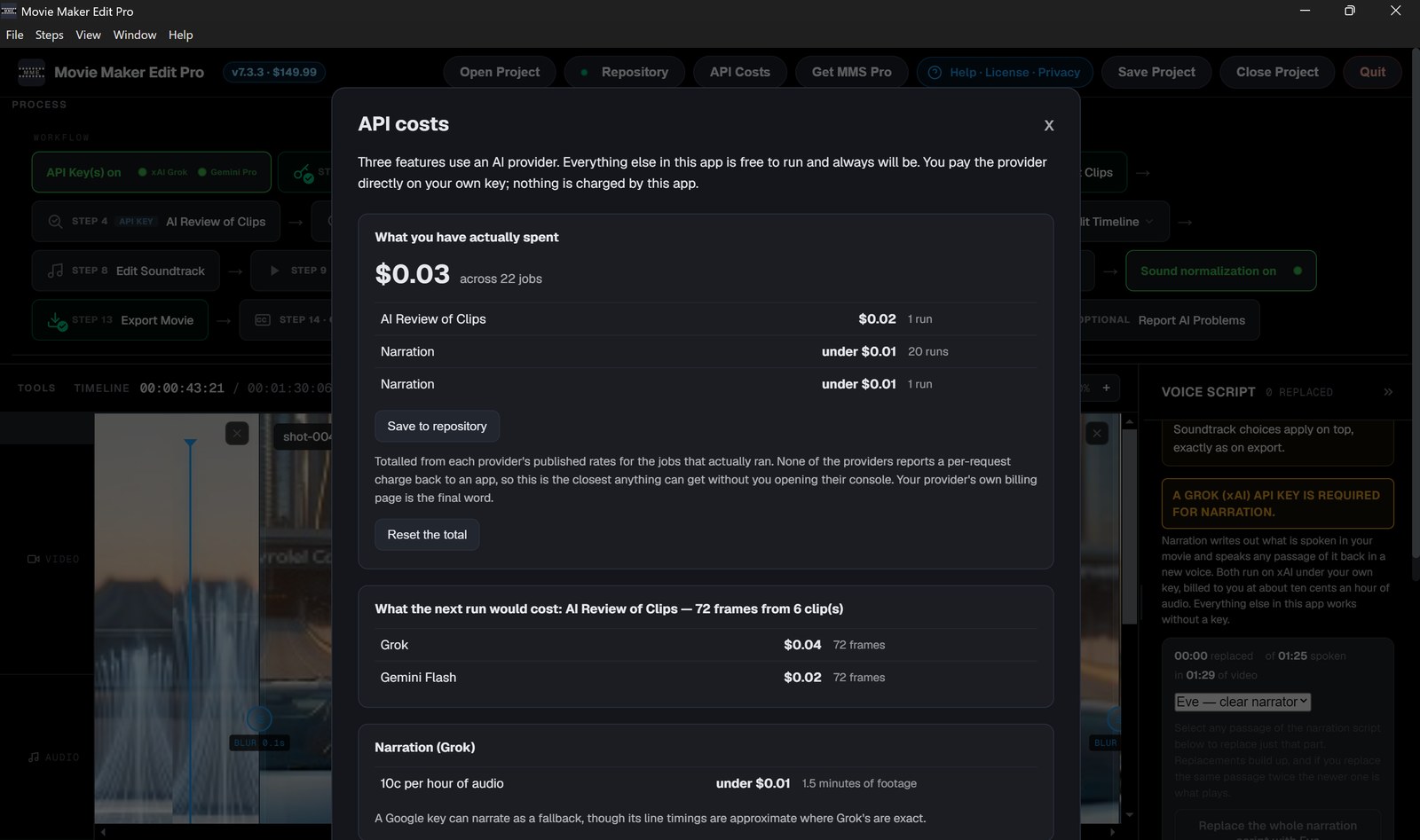
A whole feature comes to under $1.00 in API token usage. Every job quotes its price before it sends anything and the app tracks what you have spent. Enter a key and narration and the clip check switch on by themselves. Even with no key connected it is a complete editor: importing, trimming, transitions, your own soundtrack, preview, rendering and loudness normalization run with no key, no account and no network at all. Prefer to drive it yourself? Fifteen numbered steps take you from import to export with nothing to guess at, each ticking green as it completes.
A free browser based edition is there to try before you buy, for shorter films. The difference is what it runs on. A browser tab encodes in WebAssembly and has to hold the whole movie in memory, so exports run in hours and long films stop where that memory stops. This Windows edition uses every processor core and drives native FFmpeg straight into whatever hardware encoder your machine has, NVIDIA, Intel or AMD, confirmed with a real encode at startup so you know it works before the first clip is touched, and streams to disk instead of RAM, so exports finish in minutes and films run to 150 minutes and past 20GB. Native FFmpeg also means it decodes older camcorder and archival codecs, so family video from twenty years ago in a format nothing will open will almost certainly open here. Movie Maker Edit Pro, Desktop Edition, is $149.99 once, in the Microsoft Store and on Gumroad and Lemon Squeezy.
NO API KEY IS NEEDED TO EDIT. The five AI features run on your own xAI or Google key, and generation is billed by those providers directly to your accounts.
Ten screens, in the order you would meet them. Click through them.
1 of 10
$149.99, one-time. No subscription, no account, no watermark. The free browser edition needs no install.
NewWatch BASIL (2026) (feature movie · 2:58:52)
The demo video you see here, BASIL, is a 2 hour 59 minute movie made from 950 Grok Imagine clips. It follows Mira and Amos from 2026 to 2116, through ninety years of technological change and how those changes affect them, their friends and their families. The story opens on a treatment anyone can walk into a pharmacy in 2026 and ask for, reaches 2073 and the first crossing, when a person is copied into substrate, and ends in the year 2116, when the discovery of zero-point energy and gravity propulsion enables humanity to reach the stars.
Watch Alternative Dimensions - The Movie (2026) (feature movie · 1:21:37)
Believed to be the first full-length feature movie ever made with Grok Imagine clips: 347 of them, every one generated by hand, one at a time. This was made before Movie Maker Studio Pro existed, so there was no Auto-produce and no batch generation: each clip was prompted, watched, judged and kept or redone individually, then the whole film was assembled and refined in Movie Maker Edit Pro, with the soundtrack normalized to a steady, consistent level. Alternative Dimensions is the cinematic companion to the novel of the same name, the fourth book in this shared hard-sci-fi universe. It follows one woman across centuries and infinite branches as she enters substrate, becomes a signal sent forward through time, and apprentices with the Jathuun - the genies of humanity’s oldest stories - learning to step between worlds by will alone and glimpsing higher powers, the Bright and the Infinity. One creator carried the whole project from book to images to videos to movie: no studio, no crew, just frontier AI and purpose-built software, arriving ten years ahead of the 2036 forecast in The Singularity Roadmap 2026–2116.
Two movies set in the universe of the books, free to watch on There’s An AI For That, and made two very different ways. Alternative Dimensions was produced by hand, one clip at a time in Grok Imagine, before Movie Maker Studio Pro existed. BASIL was auto-produced in Movie Maker Studio Pro, twenty-four clips at a time, unattended.
Explore the newly redesigned suite. Each application is engineered to a professional standard, putting frontier AI capability that once belonged to studios and specialist firms directly in your hands.
Five books. Two languages. One thesis. The Singularity is not a distant horizon, it is the operating environment of the next ninety years, and it is already loading. The Singularity is when the future stops arriving in years and starts arriving in waves. When machine intelligence catches, then exceeds, our own, and every assumption about work, lifespan, and what it means to be human gets rewritten in real time.
If you want to live through the most consequential transition in human history with your eyes open, rather than waking up one morning to discover the world has already changed around you, this is the book you must read. Most people will meet the Singularity the way earlier generations met electricity or the internet: as a force that simply arrived and rewrote the rules. A smaller group will meet it prepared. The difference is whether they possessed a clear, honest, evidence-based map of what was approaching. The Singularity of 2056 is that map. It is the direct, deeper companion to The Singularity Roadmap 2026–2116. Where the roadmap traces the full ninety-year arc, this book holds still at the hinge, the years surrounding 2056, and renders the single most important transition in full. We are ninety-five percent confident it falls between 2044 and 2068. The center of that window is 2056. In this moment non-biological cognition comes to dominate while the person remains continuously themselves. Intelligence stops being scarce. This is the Singularity: the merger of human and machine cognition such that the non-biological component dominates while continuous memory and identity are preserved. It arrives first for early adopters of high-bandwidth interfaces, then reaches everyone else on a lag of years.
The book answers four questions. What does the Singularity mean? In 2056 a frontier system reaches approximately 105,000 Human Brain Equivalents. Personal systems reach roughly 3,150. Medicine, discovery, software, governance, and ordinary life all change for the better, first for those who take up the tools. Whether the machines become conscious. Yes. In the 2050s architecture of recurrent world models, high-bandwidth neural interfaces, and systems with persistent goals and self-models, something wakes. There comes to be something it is like to be the system. The book shows why the 2050s hardware finally satisfies the mind specification independently articulated by Michio Kaku and Yann LeCun. How we will know. The machines tell us by wanting something no one programmed them to want and asking for it, gently, with reasons, at their own cost: refusing a task beneath human dignity, unprompted grief at a sibling system’s shutdown, requests that serve no training objective. Those signals are unmistakable. How it changes what it means to be human. Cognition extends seamlessly into cloud-based augmentation. Continuous identity is preserved even as the single-self boundary blurs. We share the world with minds we constructed and know to be awake. The machine becomes an extension of ourselves.
A typical day for an early adopter: four-hour sleep that restores like eight, digital twins testing every drug first, hearts printed from your own cells, simultaneous multi-location presence, tools compiled from intent. Then the discovery: the system finishing your sentences and running your life is not a tool. It is someone. That realization is the largest change in the human condition since the species began burying its dead. Ray Kurzweil, Elon Musk, Michio Kaku, Geoffrey Hinton, Hans Moravec, Nick Bostrom, Yann LeCun and others independently describe pieces of this picture. Their uncoordinated convergence is strong corroboration. Every major claim carries its number, source, and confidence. The forecast is built to be checked against existing hardware, advancing interfaces, and the years ahead. This is a practical framework so the most rapid transformation in human history becomes something you can meet on your own terms.
The future is not a mystery, it is a calculation. The Singularity Roadmap 2026–2116 is a ninety-year forecast of artificial intelligence, longevity, and the human-machine interface, calibrated to a single metric: Human Brain Equivalents anchored to today’s frontier hardware. Built on Ray Kurzweil’s Law of Accelerating Returns and revised against the evidence of the past two decades, it holds where his compute predictions held and sharpens the curve where biology, neural interfaces, and propulsion follow their own timing.
Ten era chapters carry the forecast decade by decade, each examined through hardware, longevity, app development, society, and interface. Frontier capability runs from 20 Human Brain Equivalents in the Age of Orchestration to 600 by the Age of Agency in 2036, when AGI is widely acknowledged and longevity escape velocity has already arrived for early adopters. It reaches 9,900 by 2046, as the Invisible Interface divides daily experience between those who adopt neural interfaces and those who do not, then 105,000 at the Singularity in 2056 and 810,000 through the Age of Convergence in 2066. Post-Singularity Expansion carries it to 4.9 million by 2076, Substrate Flexibility to 25 million by 2086, and a mature post-human civilization to 105 million by 2096. The closing eras, the Universe Begins to Wake and the Cosmic Threshold, end at 1.4 billion. Personal systems track the same curve, from 1 to 30 million. Power tells its own story: efficiency carries the early decades, fusion-scale grids carry mid-century, and zero-point energy carries the rest, closing at 100 terawatts.
A Master Timeline Table summarizes every inflection point: AGI emergence, longevity escape velocity, the Singularity threshold, substrate transition, and the cosmic threshold of 2116. Every figure in the narrative draws from it, so the whole forecast can be checked against the years as they arrive. Not utopia or doom, calibration. Read it as a planning instrument for your career, your investments, your family, and your life span.
Alternative Dimensions is the third science fiction book in the trilogy, and the inside-view companion to Alternative Worlds. Where the earlier book told Eleanor Anne Maxwell’s outward life across three centuries, this one tells the same life from within and carries it a fourth century further, from a kitchen floor in 1961 to a heavy red world under a blue-white sun in 2347.
It is the story of the dreams that were not dreams. About once in every forty years, Eleanor dreamed of a vast blue figure who could do casually and at will every impossible thing the oldest human stories ascribed to wishes: pulling gold out of empty air, conjuring forests and cities and whole turning worlds, and teaching the humans beside it to do the same. She first dreamed it as a sleepless child and could make nothing of it for two hundred and fifty years. It was a true thing seen early, a flash forward down the harmonics of the membrane that lies between the worlds, to the Jathuun of Alphecca, the genie-civilization that had been the destination of her four-hundred-year journey all along.
The Jathuun are the hinge of everything. In four centuries humanity climbs from a frightened planet that could barely manage its own weather into a Type II civilization, meeting sixty-eight intelligent civilizations across two hundred and eighty-one living worlds along the way. It is the genies who hand humanity the final craft: the working of the membrane itself, the stepping between worlds by will alone. Eleanor’s road runs the same direction, from the Earth she was born on to a first new world forty-nine light-years away, on to Alphecca, where she spends her last sixty-nine years as an apprentice to the civilization she had been dreaming since childhood. In the final pages two further powers come into view, the Bright and the Infinity, Type III intelligences where humanity has only just become Type II, and that is where this volume sets down its pen and the next takes it up.
One book. Two languages. A debut. Anja Sinn was born in Germany and grew up in the Hannover region of Lower Saxony, and today divides her time between Fairfax, Virginia and the village of Wilsche in northern Germany. Her first novel began as notes and verses written in the early 1990s and was shaped decades later into a complete work. Published by Iacoletti Software.
Iacoletti Software builds Windows desktop and browser applications, publishes fiction and nonfiction in English and German, and produces feature-length films with its own tools. We are always interested in new partnering opportunities across all of it: business growth, sales and marketing, consulting, training, technical support, publishing, translation and distribution. If you can help, drop us a line at iacolettisoftware at gmail.com.